Free Medicare help is available 800-333-4114

What’s at Stake for Older Adults and People With Disabilities

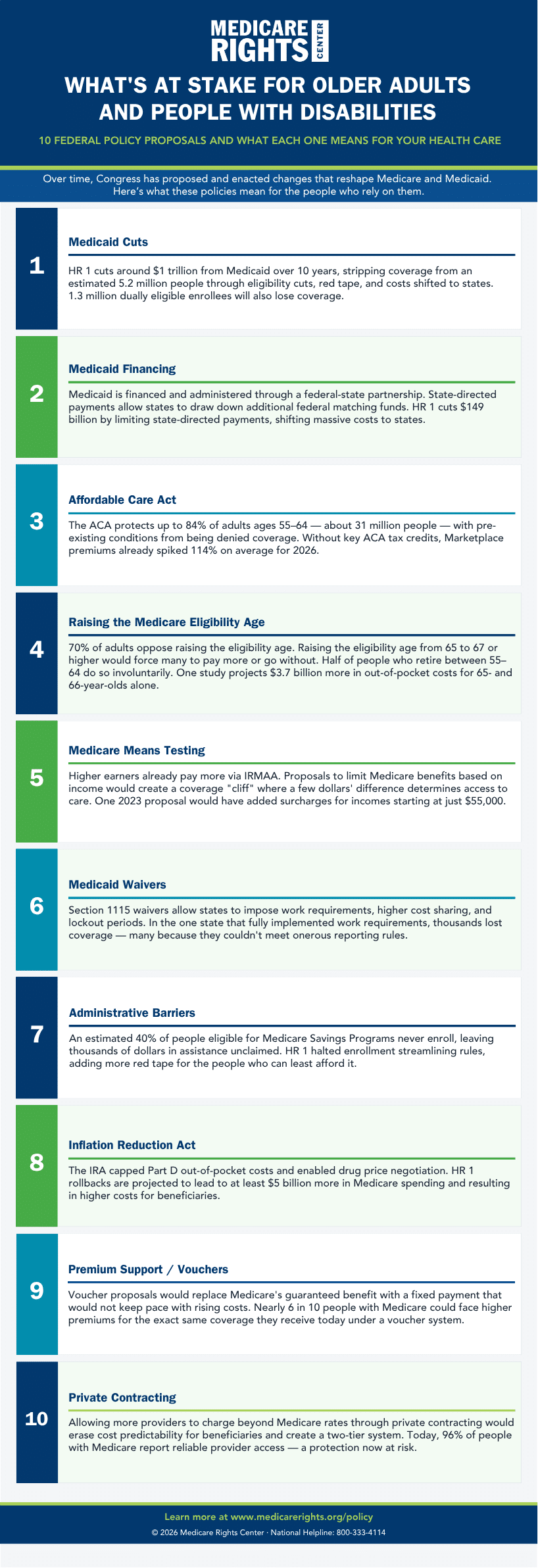
Over time, policy ideas gain and lose popularity, including several that threaten the effectiveness of major health care programs like Medicare, Medicaid, and the Affordable Care Act (ACA). In this series—What’s at Stake—we explore some of these reform ideas and how they could affect coverage, care, and outcomes for older adults and people with disabilities.

Understanding these issues is important, as it may influence how a person votes, donates to causes, or interacts with elected officials. Importantly, while some of the ideas may appear partisan, many enjoy broad support, and all are sensitive to shifting political dynamics.

This work was supported in part by the AARP Public Policy Institute. Medicare Rights Center maintains full editorial control over all of its policy analysis and communications activities.

Resources in This Series

Positions and Publications

What Medicaid Cuts Mean for Older Adults and People With Disabilities

With the passage of HR 1, Congress is cutting around $1 trillion from Medicaid over the course of the next 10 years. The cuts will affect Medicaid at every level, restricting eligibility and enrollment, driving up the cost of covered services for beneficiaries and states, and damaging the health care system nationwide. These cuts harm the people who rely on the program, including millions of older adults and people with disabilities who are dually eligible for Medicare and Medicaid, as well as people nearing Medicare eligibility who have coverage through expansion Medicaid.

Download PDF
Positions and Publications

What Medicaid Financing Means for Older Adults and People With Disabilities

Medicaid is financed and administered through a federal-state partnership. Under current law, the federal government matches state Medicaid spending based on a statutory formula, without a pre-set limit. If state spending increases, for example due to increased enrollment or unexpectedly high program costs, then federal spending increases as well.

Download PDF
Positions and Publications

What Medicare Premium Support Means for Older Adults and People With Disabilities

Some policymakers support turning Medicare into a premium support system, also called a defined contribution system or a voucher program. These programs would give people with Medicare a voucher or coupon to purchase health coverage. If the voucher did not cover the full cost—a certainty, given the aim of such programs is to save Medicare dollars—the person would presumably have to pay the rest or go without coverage. Though touted as a cost saver, a hallmark of these policies is to instead shift significant expenses onto consumers.

Download PDF
Positions and Publications

What Medicare Private Contracting Means for Older Adults and People With Disabilities

Some policymakers endorse proposals to give Medicare providers the right to charge beneficiaries more for care than is currently allowed, either through balance billing or private contracting. Under these reforms, providers could require their Medicare patients to negotiate a contract for the cost of their care, or simply charge more for Medicare-covered services, leaving those beneficiaries with additional costs on top of their premiums, copayments, and coinsurance.

Download PDF
Positions and Publications

What Raising the Medicare Eligibility Age Means for Older Adults and People With Disabilities

Medicare is a nearly universal program for people 65 and over, guaranteeing health care for older adults who have paid into the system during their working lives. This ensures that older adults do not have to continue to rely on employer health insurance and can retire at 65 without risking coverage loss. Some policymakers want to delay access to Medicare by raising the eligibility age from 65 to 67 or even 70. This would disproportionately harm people who can least afford it, including people who work in physically demanding jobs and older adults of color.

Download PDF
Positions and Publications

What the Affordable Care Act Means for Older Adults

The Affordable Care Act (ACA) strengthened Medicare and Medicaid and created important coverage avenues and consumer protections for people of all ages. Despite these successes, the health law continues to face opposition from some policy corners in Congress, the states, some presidential administrations, and the courts.

Download PDF
Positions and Publications

What the Inflation Reduction Act Means for Older Adults and People With Disabilities

The Inflation Reduction Act (IRA) of 2022 made key changes in Medicare law and coverage to improve prescription drug affordability for older adults and people with disabilities. Since its passage, however, some stakeholders and lawmakers have targeted IRA policies for revision or repeal, especially the law’s Medicare Drug Price Negotiation Program.

Download PDF

Videos

Infographics

Have a Medicare question? - Poop

Our trained counselors are here to help — free, confidential, and personalized to your situation. - Poop

800-333-4114 Monday - Friday, 9 AM - 5 PM ET Get Help - Poop →

Become a Medicare Champion

2,400+ Champions stand with older Americans. Your gift keeps the helpline free, the policy work loud, and the next 30 years possible. Will you join them?

Become a Champion →